In-store Media Readiness Assessment
Is your store a medium, yet?
One venue measured and judged in four to six weeks, for a fixed fee, before a single screen is bought.
- Fixed fee
- 4 to 6 weeks
- One venue
- One verdict
Trusted by leading European retailers





Your store already gathers an audience. We measure what it is worth, what it reveals, and whether it can be sold.
In four to six weeks you get one reach number, an indicative media value at an assumed CPM, a verdict on whether the company is set up to sell the space, and a clearer view of how customers use the venue. For a fixed fee, before a single screen is bought.
It settles three decisions: whether to buy screens, whether to run a pilot, and whether to offer the venue as media inventory.
Is the space worth money?
Measured footfall, screen positions, how many people a campaign reaches.
Could you sell it if it were?
Who owns the space, who reports it, whose budget pays for it.
What decision it supports
A first pilot, a clear no, or a better use of the data before screens are bought.
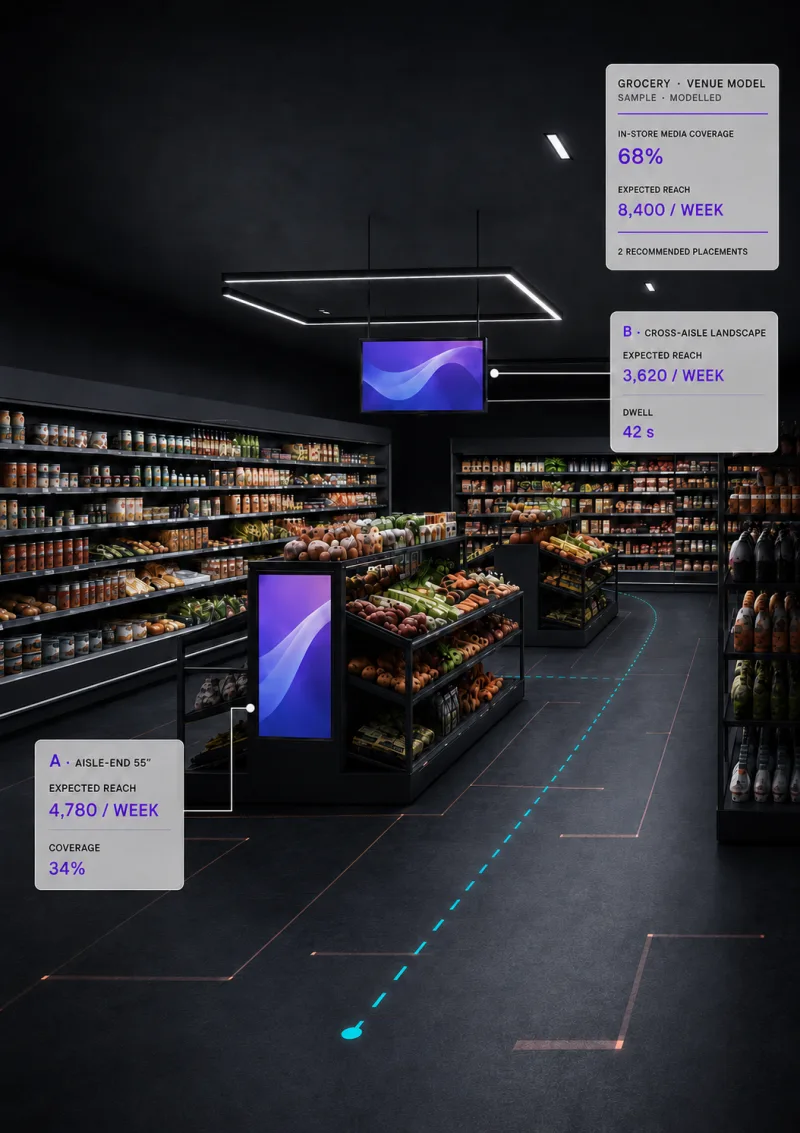
What the model does with one venue
Assessment format
Assessment format
One venue
both modules, five outputs, fixed-fee scope
4 to 6 weeks
including a measured footfall baseline
Further venues
in the same chain, with a lighter repeat setup
The fee is fixed and quoted per venue on request. Not included: screens, their installation, content, and selling the media space.
What lands on the table
What lands on the table
-
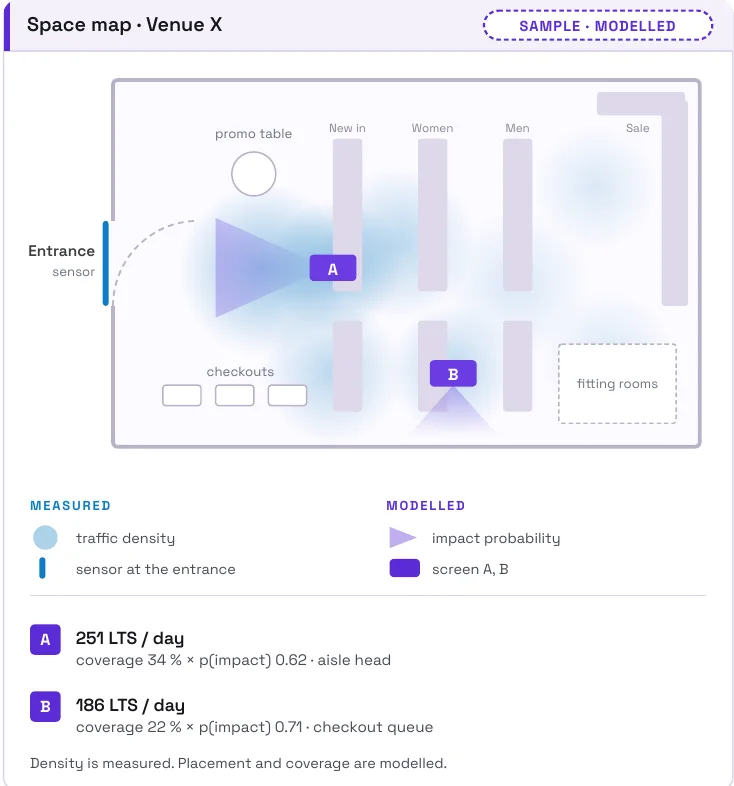
Space map : where the screens belong, and why.
-
Venue model : visits in time, in place, by audience, and what that reveals about customer behaviour.
-
Reach prediction : how many likely-to-see impressions a budget buys.
-
Measurement plan : what proves the prediction after deployment.
-
Readiness verdict : ready, ready with conditions, or not yet.
What we need from you
-
A floorplan, in any format.
-
Ceiling and shelf heights, photos from a phone.
-
Where a screen may hang, and which category sits where.
-
Half a day of your team.
-
Footfall data if you have it. If not, ours can run for a few weeks.
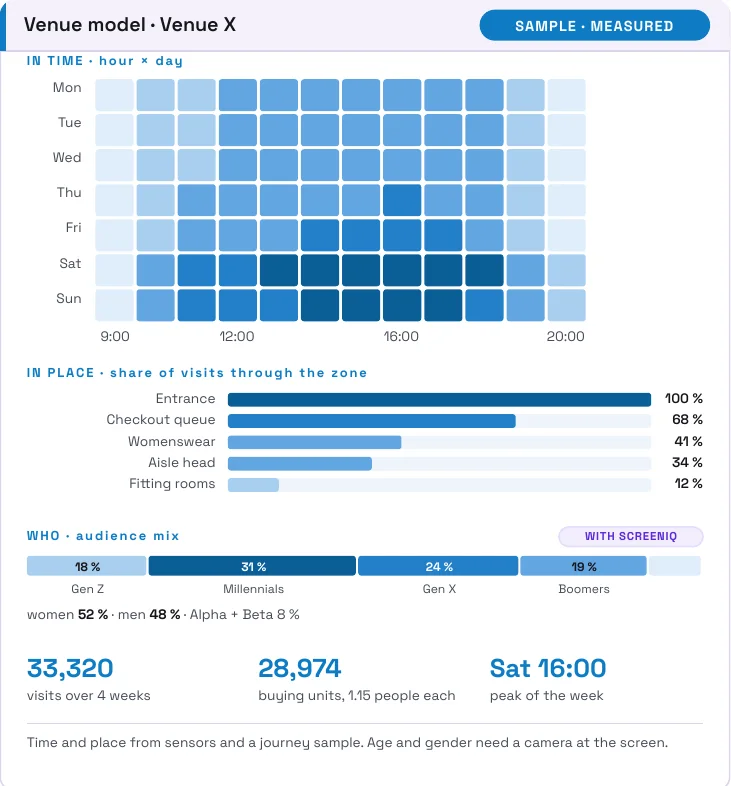
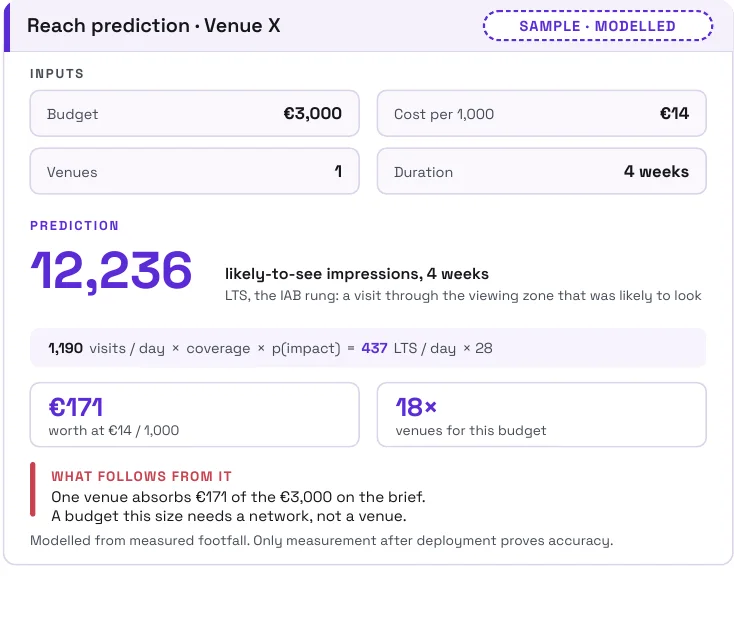
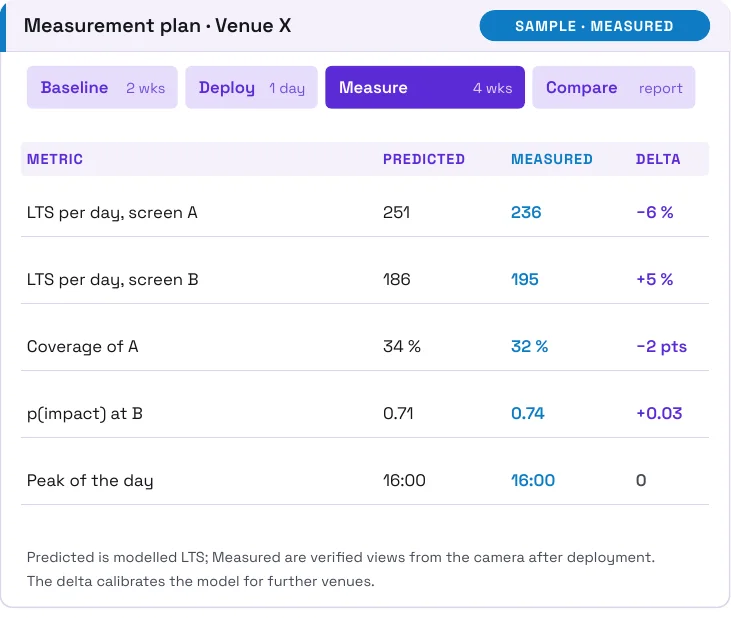
Every figure is sample data, marked as such in each frame. Real figures come from the survey and the measurement of a particular venue.
How the answer looks
How the answer looks
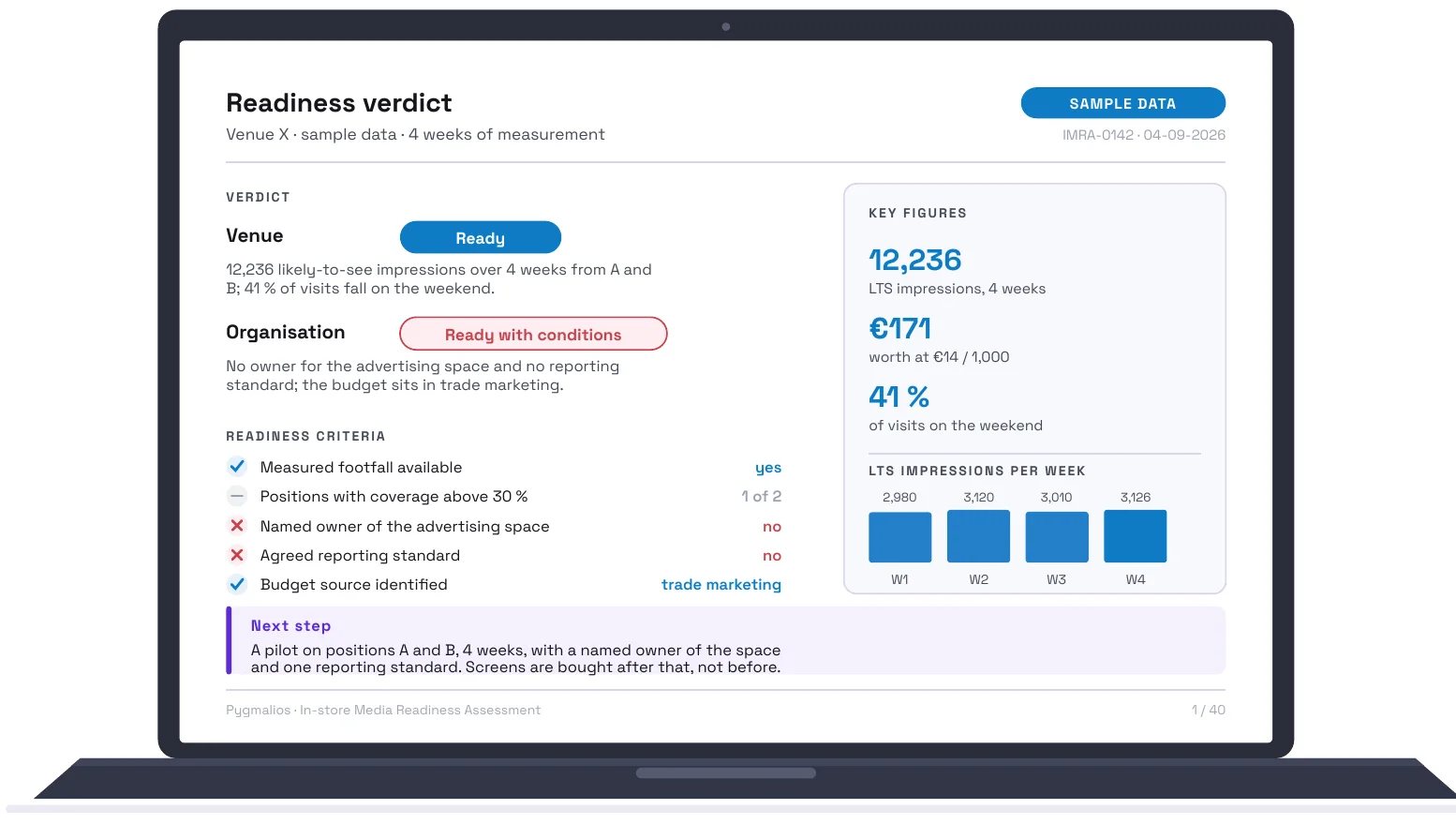
If the venue is ready, the next discussion is practical: pilot scope, required technology and proof of performance.
Measured with our products
Measured with our products
From Our Knowledge Hub
Recommended Reading

How to Measure Digital Signage Audience in Stores
Learn how to measure digital signage audience in stores — a practical framework turning screen impressions into credible, advertiser-ready data.
Read article →
Retail Media Network Economics for CFOs
Retail media network economics for CFOs: the 60–70% margin case, why measurement makes or breaks it, and six financial controls to demand.
Read article →
Retail media's next budget is waiting for a referee
Marketers plan to spend more on retail media and trust the measurement less. In-store is missing from Europe's statistics because its numbers don't compare. What the IAB standards ask a retailer to show before the first screen is bought.
Read article →Next step
The fastest way in is a half-hour call about one venue you are considering
On that call we tell you whether a full assessment is likely to add anything material, for media value and for customer insight. If not, we say so.
Prefer to read first?
The full leaflet goes deeper: the two modules item by item, the five outputs on sample data, the limits, and why one venue is measured but a network is bought.
Free PDF. One e-mail, the leaflet, done.
Book the assessment call
2,000+
locations live
250M+
sessions analysed
20+
countries
Questions
Frequently asked
Does the assessment install anything in the store?
No. The assessment itself installs nothing and needs no cameras in the store, which is why it clears reviews a camera project would not. Footfall data from your own counters, or from Traffic Analytics or Journey Analytics running for a few weeks, narrows the reach figure from a range to a number.
How long does it take, and what does it cost?
Four to six weeks for one venue, two of which are the sensor baseline and run without your involvement. The fee is fixed and quoted per venue on request; each further venue in the same chain adds about a week and costs a fraction of the first.
What is a likely-to-see impression?
A visit through the viewing zone of a screen that was likely to look at it: visits times coverage times the probability of impact from dwell and orientation. It is the rung of the IAB impression ladder just below a verified view, which is what ScreenIQ by Pygmalios measures after deployment.
Does it identify individual shoppers?
No. We work with a venue model and a sensor sample, with dwell and orientation. Nothing about an individual person is collected or inferred.
What do we get at the end?
One report with five outputs: space map, venue model, reach prediction, measurement plan and a readiness verdict for the venue and the organisation, with a named first pilot or a clear no. The floorplan and the model are files you keep.
Is one assessed venue something a brand can buy?
Not on its own. What is sellable is venues joined into a network with one brief, one budget and one report. The assessment is a step towards that.
Page version of 9 September 2026. The visuals are schematics of the mechanism on sample data.