Thought Leadership
The (R)Evolution of Telecom Retail Store:
A Step into the Future
To become one of the industry leaders in telecom retail, one has to be prepared to take the customer journey to a whole new level, both online and offline. Here are several insights that will inspire you to start on the right foot.
Brought to you by Pygmalios
Overview
Key Takeaways
Start small
Don't wait until you develop the complete system, that's overwhelming. Start with the highest-value use cases and work from the bottom up.
Focus on real-time data and daily trends
In 2021, customer traffic in telecom stores has been missing one crucial thing — a stable trend across time. This leads to forecast uncertainty and the increased significance of real-time and daily data.
Keep creating the omnichannel experience
Everything starts and ends with the customer. In omnichannel, the "where" a purchase occurs ceases to matter as the physical and digital worlds integrate into a network of channels.
Make your sales consultants brand ambassadors
The in-store consultants need to become product experts and brand advocators. Achieve this by providing up-to-date information, training, or consultations.
Avoid pushing generic information
Nowadays, true customer loyalty is built through personalized products and services.
Prompt customers to self-identify
Without identifying the specific customers, you cannot deliver a personalized experience. When switching between channels, customers expect to pick up where they left off.
Digitalize critical store processes
The investments already made by many telecoms are to implement an online appointment scheduling for store visitors or to fully automate employee scheduling.
Industry Voices
Retail shopping as we know has changed
Testimonials of our telecom partners speak about how COVID-19 forced the industry to innovate and rethink its approach to customer service.

"The health of our employees and customers has been the number one priority from the start. From there, we could focus on bringing the business up to speed by embracing new activities in our stores like serving our customers over the phone and much more."
Impact on the day-to-day business was tremendous, but telecom retailers have stood their ground. After having established all necessary health-related precautions, they continued with keeping business afloat.

"Our customer service department redistributed responsibilities among the employees boosted their ranks to better help customers, both over the phone and online. We do whatever it takes so our customers can do everything from the comfort of their home during the pandemic regulation restriction period and remain satisfied with our service."
Service hybridization is one of the ways to manage strain put on the limited personnel due to COVID-19 restrictions. Many of our local telecom partners have opted to start using telesales more.

"Even though the pandemic situation has become better, some people are still afraid to visit our stores in person. It's a period of many unknowns as we're still getting used to the new patterns in customer behavior. Many of them have fully embraced digital technologies, while others have started calling more."
Telecom retail finds itself in a transitional phase. While it might not be possible to walk down to the store in person every time during the year, statistics show a positive future is in the cards for the telecom retail industry — if specific actions are carried out.
The evolution of in-store visits from 2019 to 2021 in weeks

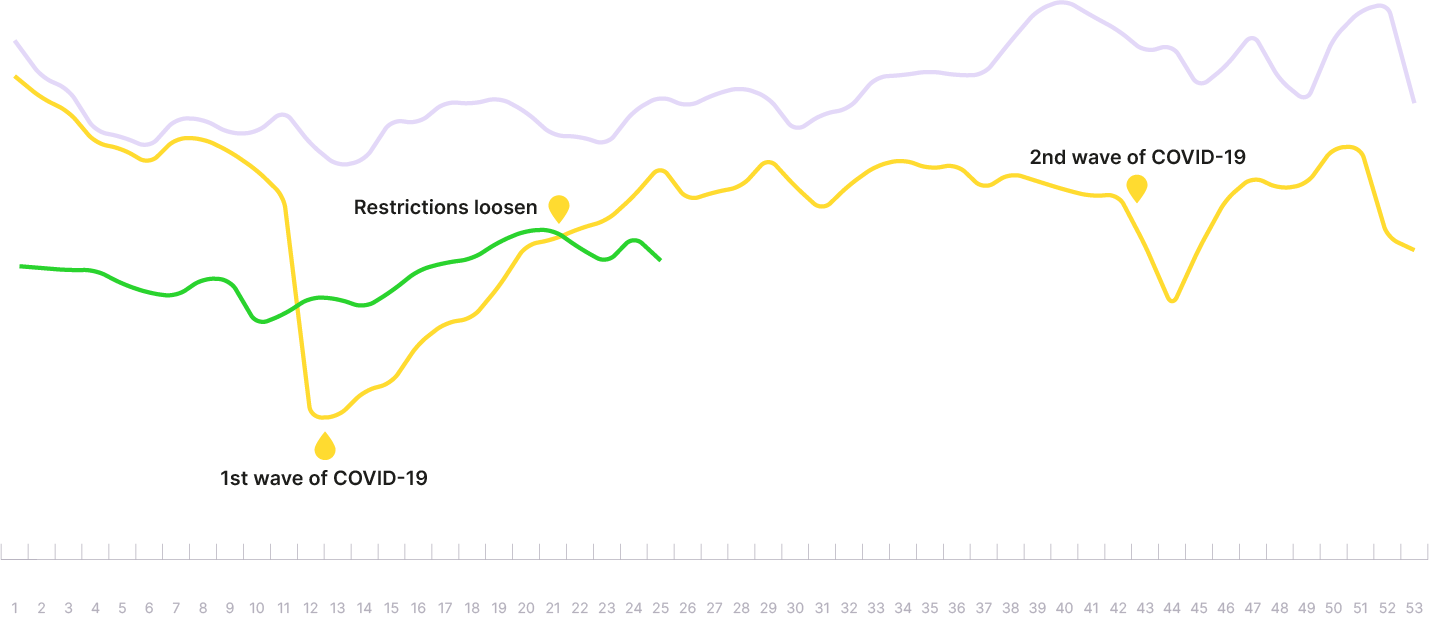
The average customer traffic today amounted to approximately 56% of what it used to be in 2019. Compared to customer traffic of 2020, it sits at around 86%. However, there is one thing missing in the statistics, which keeps everyone on their toes — predictability of customer traffic.
Because of this reason alone, the telecom retail industry should focus on real-time data and daily trends. Learning your customers' behavior and needs helps you act upon the learnings quickly and employ adequate measures.

It is time to walk the walk
Accenture found that 25% of customers use the store as a means of evaluating products, 60% use it to ask for advice. Put simply, if your retail store serves as the decision-driving element and the customer orders online, it is still a win. It is an example of an omnichannel approach. It applies to other findings:
- • When switching channels, three out of four customers expect to pick up where they left off — not having to re-enter information or re-inform a customer service representative of their issue.
- • 70% of customers who start in a retail store convert close in a different channel, getting the physical/digital mix right is essential.
Customers of today expect the top-notch, tailor-made experience to convince them to leave their homes and venture into the store. This process needs to be guided from the very first moment your customer uses any of your contact points. To achieve this, here are three actions to consider:
Action 1
Omnichannel approach
The most important thing right now seems to be creating a flawless, uninterrupted customer experience so your customer can start or continue from any point of their journey.

"Customers are pre-shopping digitally, doing their comparison shopping before entering a physical store. The customer shopping journey is across channel, starting online and continuing offline."
"The post-pandemic situation has clearly shown us how an omnichannel approach is necessary for the business to thrive again. Stores and channels communicating with one another in real-time and being optimized for your customers' specific needs should be the new standard."
One of the crucial milestones in embracing omnichannel is intertwining the physical world with the digital one. Think about creating a local, digital marketing campaign that would target all your customers within the close vicinity to your retail store — offer a special discount on a specific day to fill up less frequented periods during the week, for example.
One of our telecom clients reported a decrease in motivation and burn-out of the sales consultants as one of the biggest challenges COVID-19 brought so far. Providing employees with incentives that lead to the ability to make them the true retail experts is therefore crucial.
"The sales staff need to be true brand ambassadors, and they need to be product experts. This will be the differentiator for a customer going to one store versus another, outside of price comp shopping."
In the omnichannel approach, telecom stores will become part of a seamless network of multiple channels, each underpinned by digital technology. Their synergy lies in the compartmentalization of stores, leading your customer to the one that fits his needs the best.
One of the stores can serve as a pick-up point with speedy and convenient service while the other one can act as a showroom with upselling capabilities. This will require rethinking the store's strategy in customer engagement and the format of the store itself.
Store Innovation
Sample telecom store formats

Classic
A full-service store that keeps a whole portfolio of products.

Convenient
Adjusted to mainly serve local clientele and manage urgent requests with limited offerings.

Express Pickup
Customers can pick up their online orders or book a free appointment with a representative.

Experiential Showroom
Offers new and innovative ways for customers to experience and engage with products.

Pop-up
Manned or unmanned, this type of a store changes locations and drives brand awareness.

Pop-in
Creates potential for new traffic by operating in another brand's store or a department store.

Kiosk
Self-service machines that are designed for quick transactions and on-the-go products.
Furthermore, an omnichannel approach is not just about the experience within your store but about the process as a whole — outside of your store boundaries included. Deliveries outside matter as much so do not keep your customers waiting. More than 90% of customers view 2-3 days deliveries as the baseline, and 30% expect same-day delivery.
Action 2
Personalization
When preparing all the different touchpoints (digital screens, kiosks, tablets or app downloads) for your customers, make them a part of the dialogue. Transforming the in-store experience should evoke emotion and make it relatable for your everyday consumer.
Physical stores will never be as fast and convenient as their online counterparts. However, one can learn from the other and vice versa. The physical store should introduce comfort and a more streamlined experience for the customer while the presence of actual employees at the store reinforces the decision-making process with a personal touch.

How it often looks today
The in-store customer journey is often not personalized, which leads to lost conversion opportunities.
Pre-visit (awareness)
Telecom window displays are usually generic without any targeted display advertisements.
During visit (conversion)
Upon arrival, the customer is not immediately recognized and so their journey cannot be personalized.
Browsing behavior is not tracked and no data is collected to help generate recommendations.
Post-visit (targeting)
If no transaction occurs, no data is collected and the retailer may not acknowledge the customer's presence.
If a transaction occurs, the retailer acknowledges the customer only at the end of their visit.
83 percent of customers say they want their shopping experience to be personalized in some way, and research by McKinsey suggests that effective personalization can increase store revenues by 20 to 30 percent.
Keep contextual and location data in your sights as well. Prompting the customer to self-identify during the visit should be done as openly as possible — asking for an email address or a phone number, with a tangible benefit in return.
It's also a good practice to have special promotions at the ready, exclusively for your store's visitors to further incentivize their effort. This will enable you to target specific audiences with relevant messages and offers whenever they take a step inside your retail store.

How it should look in the future

Pre-visit (awareness)
Incentivize customers to visit by a local marketing campaign within the walking distance to the store.
Send personalized ads based on the type of current offering.
During visit (conversion)
Make use of a mobile app for in-store guidance and digital experiences.
Track customer behavior in store and offer recommendations based on their location within the store.
Utilize sales consultants to guide the customer while browsing and make suggestions based on purchase history.

Post-visit (targeting)
Target the customer with a follow-up content and create the opportunity for upsell by personalizing product or service offerings.
Nourish your customer's loyalty by avoiding generic, default information and build personalized promotional materials and recommendations that will make their journey feel special. Studies show customer loyalty should be at the forefront of priorities and special upsell and rewards programs can contribute to increased consumer spending.
Action 3
Digitalization
With COVID-19 looming in the distance, the game strongly favors the online landscape. To even the odds, telecom retail stores must embrace digital technology, rather than compete with it.
The importance of digitalization in the telecom retail stores of the future is twofold. For one, digital touchpoints enable the customers to continue where they left off. Second, interacting with digital screens, kiosks, tablets, and downloading apps are not only great ways to stay in touch and keep the flow uninterrupted but also means of gathering vital information on your customer's likings and shopping behavior.
Removing friction in the decision-making process — digitalization can also help reduce queueing up in stores. Online appointment scheduling for store visits has been adopted by a large number of telecom providers already and we have been hard at work to provide the same service to our partners as well.
Workforce optimization provides your employees with opportunities for a better work-life balance with apps that will generate monthly work schedules based on prediction from traffic, sales, and employee-specific data. The staff can earn a premium by taking up a hard-to-fill shift or proactively reacting to a busy period within the company.
How do you see the future of telecom retail shopping?
For starters, we recommend starting small, introducing incremental changes to ease your customers into the new world of telecom retail stores. Focus on real-time data, use it to prepare strategies that will woo more customers towards your brand, and build strong bonds with an omnichannel approach.
The Telecom retail industry is changing. Take your customers along for the ride and show them you care by personalizing their journey and making it more convenient by embracing new digital technologies.